
21 May From Distance to Method
Before this project became an archive, it was first a road, a bicycle, a camera, and a body moving through heat, fatigue, uncertainty, and distance.
When I first began long-distance cycling, I did not yet know how to describe what I was doing. At that time, cycling was not an academic method, not a digital humanities project, and not a carefully designed archive. It was more direct than that. It was a way of testing the body, of leaving a familiar place, of discovering whether a person could continue after comfort had disappeared. My first long journey in China gave me this basic experience of movement. The road was not romantic in the beginning. It was hot, heavy, ordinary, sometimes dangerous, and often repetitive. There were cities, bridges, provincial roads, trucks, dust, hunger, and the strange silence that appears after many hours of riding. But precisely because of this ordinary difficulty, cycling began to teach me something that could not be learned only from books.
On a bicycle, geography is not abstract. A hill is not only a contour line on a map; it is breath, sweat, muscle, impatience, and sometimes anger. Distance is not only a number; it is time passing through the body. A road is not only infrastructure; it is a social space where one must negotiate with cars, weather, signs, animals, strangers, and one’s own fear. Later, during my study years in Italy, this experience became more complex. I was no longer only a young cyclist trying to prove endurance. I was also a student of philosophy, history, theology, religion, computer science, and photography. These different disciplines changed the way I understood movement. The bicycle gradually became not only a vehicle, but also a method of observation.
Philosophy taught me to ask what kind of self is produced by difficulty. History taught me that roads are never innocent; they carry armies, pilgrims, merchants, migrants, tourists, and local memories. Theology and missiology taught me to pay attention to hospitality, vulnerability, pilgrimage, and the encounter with strangers. Computer science taught me that memory can be structured, processed, visualized, and made reproducible. Photography taught me that a moment becomes evidence only when it is framed, preserved, and later interpreted.
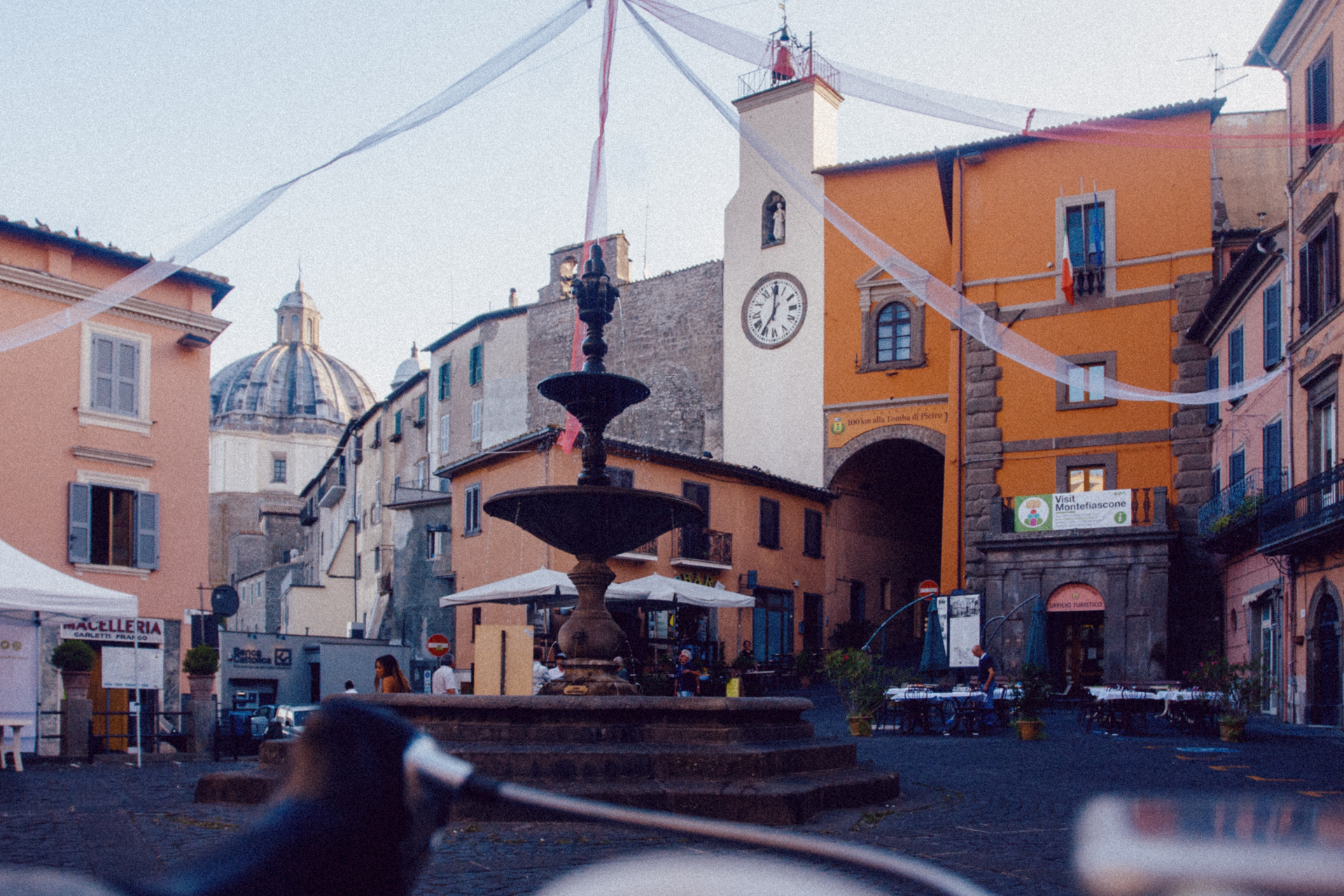
The Via Francigena journey in 2017 stands at the crossing point of these interests. At the time, I did not fully understand it in this way. I was simply trying to move from Rome toward northern Italy, following parts of an old pilgrimage route with a loaded bicycle, a DSLR camera, GPS tracking, and limited certainty about each day’s shelter. I was a student, a foreigner, a cyclist, and a temporary pilgrim. I carried too much luggage. I photographed roads, signs, villages, bicycles, churches, fields, and moments of exhaustion. I followed digital tracks while also depending on very old forms of human trust: asking for directions, looking for water, finding a bed, accepting help, misunderstanding rules, and learning how fragile hospitality can be.
At the time of the journey, the Via Francigena was not a clean spiritual symbol for me. It was a road made of asphalt, gravel, bureaucracy, heat, hunger, and small acts of kindness. Sometimes it felt like pilgrimage. Sometimes it felt like logistics. Sometimes it felt like failure. Sometimes the most important event of the day was not a church, a monument, or a landscape, but a room, a meal, a warning from a stranger, or a refusal at a reception desk.
This is why the journey remained important to me. It did not give me a simple heroic story. It gave me a dense experience of being exposed to the world. The road made visible the dependence that everyday life often hides. On a bicycle, one quickly learns that independence is never absolute. Even when travelling alone, one depends on roads built by others, signs placed by others, maps drawn by others, food prepared by others, and shelters opened or closed by others.
For several years after the journey, the materials remained scattered. The photographs were stored in folders. The GPS traces existed as KML files. The diary notes remained private. Certain memories were vivid, while others were almost lost. The journey existed, but not yet as an archive. It was a collection of traces without a stable form. Returning to these materials in 2026 changed their meaning. I was no longer only remembering the trip emotionally. I was able to read it through data, images, coordinates, timestamps, and narrative fragments. The road could be reconstructed not as a perfect memory, but as a layered document. This retrospective distance is important. The person who rode the Via Francigena in 2017 is not exactly the same person who interprets the archive in 2026. The earlier self was more immediate, more tired, more uncertain, and often more naive. The later self has more tools, more technical knowledge, and more academic language. But the later self also depends on the earlier self’s traces. Without the photographs, GPS files, and diary notes, the journey would remain only memory. Without memory, the data would remain empty.
This is the reason for building Kinesis & Praxis. The name itself contains the central tension of the project. Kinesis refers to movement: the physical act of crossing space, the bicycle in motion, the body changing position day after day. Praxis refers to practice: the reflective, ethical, and technical work through which movement becomes meaningful.
The project is therefore not only about where I went. It is about how movement becomes knowledge. It asks how a road can be read, how a private diary can become a public essay, how a photograph can become metadata, and how a journey can be transformed into a digital cultural archive without losing its bodily and personal truth.
The use of AI in this project belongs to this retrospective process. AI tools helped describe images, organize visual details, and synthesize public-facing prose from private notes and photographic evidence. But AI is not the author of the journey. It did not feel the heat, climb the hills, misunderstand the road signs, or search for shelter at night. Its role is secondary and interpretive. It assists in rereading the archive, but the archive begins with lived experience.
In this sense, the project also reflects on the condition of memory in the digital age. A journey today leaves many kinds of traces: photographs, GPS tracks, timestamps, device logs, messages, bookings, and online maps. These traces can easily remain fragmented, or they can be reorganized into something more durable. The question is not simply how to store data, but how to make data speak responsibly. I did not want the Via Francigena materials to become only a nostalgic travel album. I also did not want them to become only a technical demonstration. The aim was to hold together both sides: the human and the computational, the road and the code, the body and the interface, the diary and the map. For this reason, the WordPress site functions as an entrance, while the interactive map functions as the main exhibition space. The homepage, collection, exhibition articles, and about page offer context. The map offers the full spatial narrative. Together, they form a public structure around what was originally a private journey.
Looking back, I can say that cycling gave legitimacy to several parts of my life that once seemed disconnected. It connected study with experience, photography with geography, theology with hospitality, computer science with memory, and personal uncertainty with public form. The road taught me that knowledge is not always produced by standing still. Sometimes it is produced by moving slowly enough to suffer the details. Sometimes understanding comes from the pressure of the saddle, the weight of the bags, the gradient of a hill, the silence after a refusal, or the relief of a stranger’s kindness.
Kinesis & Praxis: The Via Francigena Archive begins from this conviction: that a journey is not finished when the body arrives. It continues in memory, in interpretation, in data, in writing, and in the responsibility to give form to what once passed through the world as movement.
No Comments