
23 Apr AI, Memory, and Retrospective Distance
The use of AI in this project did not begin from a desire to replace memory. It began from the opposite problem: memory was too human, too unstable, and too incomplete to stand alone.
The Via Francigena journey happened in 2017. The archive was built years later. Between the event and the interpretation there is a distance of time, and that distance changes everything.
Some memories remain vivid. I remember heat, certain roads, certain rooms, the feeling of being refused, the relief of food, and the strange comfort of seeing my bicycle waiting beside a wall. Other memories have weakened. Some places remain only because a photograph exists. Some coordinates mean nothing until an image gives them texture. Some images are visually clear but emotionally uncertain.
This is the condition of retrospective work.
To return to old materials is not simply to recover the past. It is to negotiate with what remains. Photographs, GPS tracks, diary notes, and metadata each preserve something, but none of them preserves the whole experience.
AI entered the project as a tool for organizing and rereading these fragments.
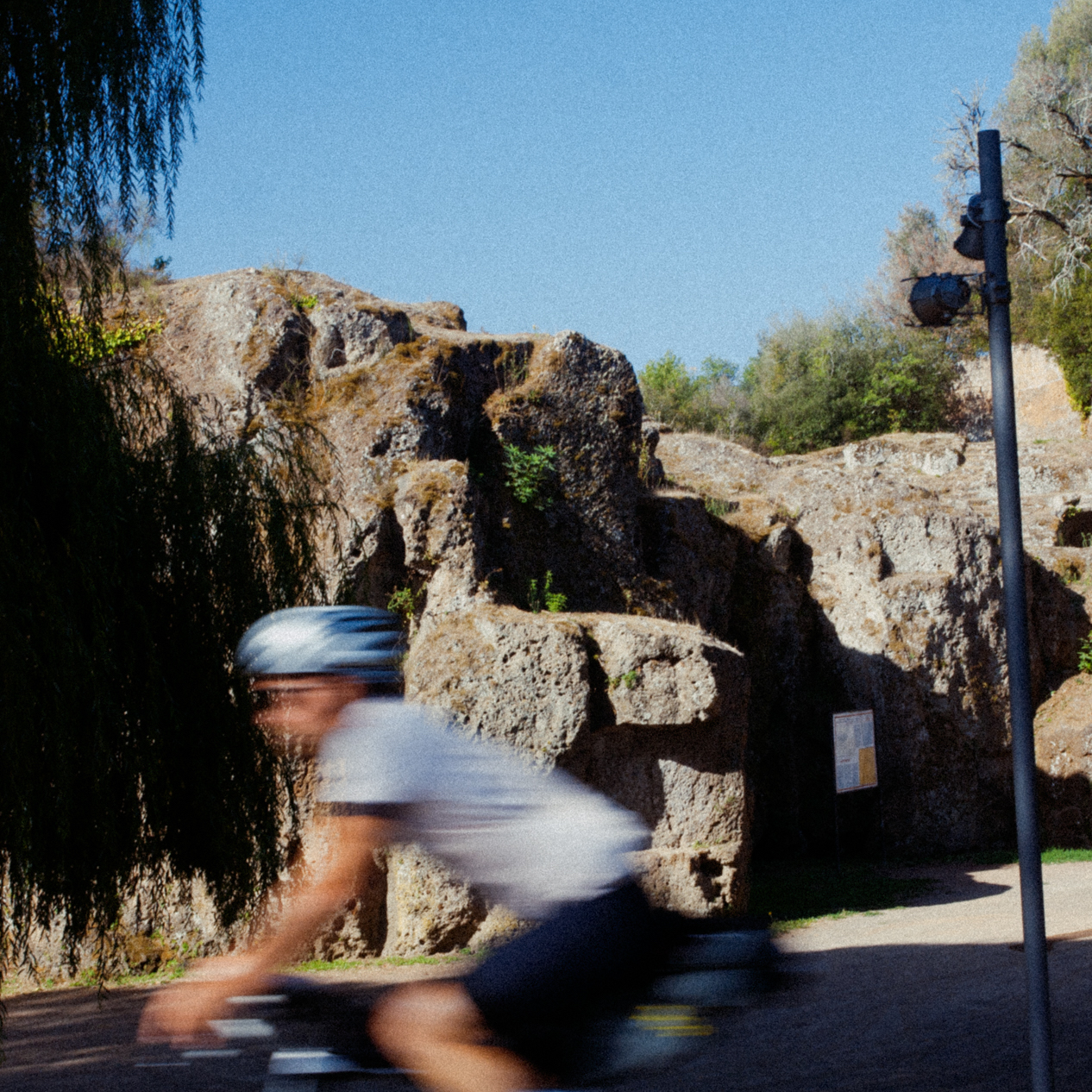
Vision models helped describe photographs: roads, signs, bicycles, buildings, vegetation, weather, spatial composition. Language models helped synthesize diary notes and visual metadata into public-facing prose. The goal was not to produce fiction, but to create an interpretive layer that could connect private memory with visible evidence.
This is an important distinction.
The AI did not ride the bicycle. It did not feel the sun, misunderstand the road signs, search for shelter, or experience embarrassment in a foreign language. It could not know what the journey meant from inside the body. But it could help me look again at the materials, notice patterns, and transform scattered evidence into a readable structure.
In this sense, AI functioned almost like an external reader.
It looked at the archive without sharing my original fatigue. This distance was useful. Human memory tends to protect certain emotional interpretations. It repeats the stories we have already told ourselves. A machine description, although limited, can sometimes return attention to the image itself: the road surface, the sign, the wall, the shadow, the bicycle position.
But this distance also requires caution.
AI can describe confidently without understanding personally. It can produce coherent language that may feel more complete than the evidence allows. It can smooth rough memory into elegant prose. It can make uncertainty disappear too easily. For a project based on lived experience, this is dangerous.
Therefore, I treated AI output as material for editing, not as final authority.
The archive needed human judgment: what should be made public, what should remain private, which emotional tone was accurate, where the machine was too generic, where the original diary was too intimate, and where the photograph required more careful interpretation.
This project is therefore not a celebration of AI as magic. It is a practical experiment in AI-assisted retrospection.
The key question is not whether AI can write about a journey. The deeper question is whether AI can help a person return responsibly to old traces and build a public form from them. Can it help organize memory without replacing it? Can it help describe images without pretending to have lived them? Can it assist interpretation while leaving space for uncertainty?
Kinesis & Praxis answers cautiously: yes, but only if the human archive remains central.
AI is useful here because the project is not only emotional memory and not only raw data. It is a layered system: private diary, public essay, photograph, coordinate, caption, map movement, interface design, and retrospective reflection. AI helps move between these layers, but it does not own them.
The past is not automatically recovered by technology. It must still be read, edited, doubted, and cared for.
In the end, the most important part of the archive is not that AI was used. The most important part is that the journey could be revisited with enough distance to become meaningful again, and with enough care not to become false.
No Comments