
18 Apr The Road as Public Space
A road may appear neutral. It seems to be a surface for movement, a line connecting one place to another. But during a long bicycle journey, the road reveals itself as a complicated public space.
It belongs to everyone, and yet not everyone belongs to it equally.
Cars, trucks, bicycles, pedestrians, animals, local residents, tourists, pilgrims, and workers all use the road differently. Each has a different speed, weight, vulnerability, and social legitimacy. A cyclist with luggage occupies an uncertain position among them. He is slower than cars, faster than walkers, more exposed than drivers, and more visible than ordinary pedestrians.
This visibility can be uncomfortable.
On the Via Francigena journey, I often felt that the bicycle made me both present and out of place. In small towns, I had to decide where to stop, where to lean the bicycle, where to take a photograph, where to rest without disturbing others. These were small decisions, but they revealed the politics of public space.
Where may a stranger pause?
This question may sound simple, but on the road it becomes serious. A tired cyclist needs shade, water, food, and sometimes a place to sit. Yet every place already belongs to some social order. A doorway belongs to a house. A wall belongs to a building. A parking space belongs to a car. A church entrance belongs to ritual and local expectation. A fountain belongs to everyone, but even there, one must behave correctly.
Fatigue does not give automatic permission.
I learned this through small frictions. A bicycle placed too close to a car could become a problem. A photograph taken too openly could feel intrusive. A pause in the wrong place could make one feel like a foreign body in a local environment. These moments were not dramatic, but they were important.
Travel writing often prefers larger scenes: landscapes, hospitality, danger, revelation. But the everyday experience of movement is made from smaller negotiations. The road is not only crossed. It is entered, used, interpreted, and sometimes contested.
The cyclist must constantly read signs that are not all written.
There are official signs: speed limits, road numbers, directions, warnings, pilgrimage markers. But there are also social signs: the way people look, the position of cars, the rhythm of a town square, the difference between a public bench and a private threshold, the silence of a road where one should not remain too long.
This form of reading is practical and bodily.
The road also reveals inequality between modes of movement. Cars occupy space with confidence. They are protected by metal, speed, and habit. A bicycle is light, narrow, and vulnerable. It must negotiate with traffic not only through law, but through fear. Even when a cyclist has the right to be on the road, he may not feel that the road recognizes him fully.
This is especially clear on provincial roads, where the landscape may be beautiful but the infrastructure is not gentle. A narrow shoulder, a blind curve, a fast truck, or a broken surface can change the meaning of a place completely. Beauty and danger are often present at the same time.
The archive tries to preserve this double vision.
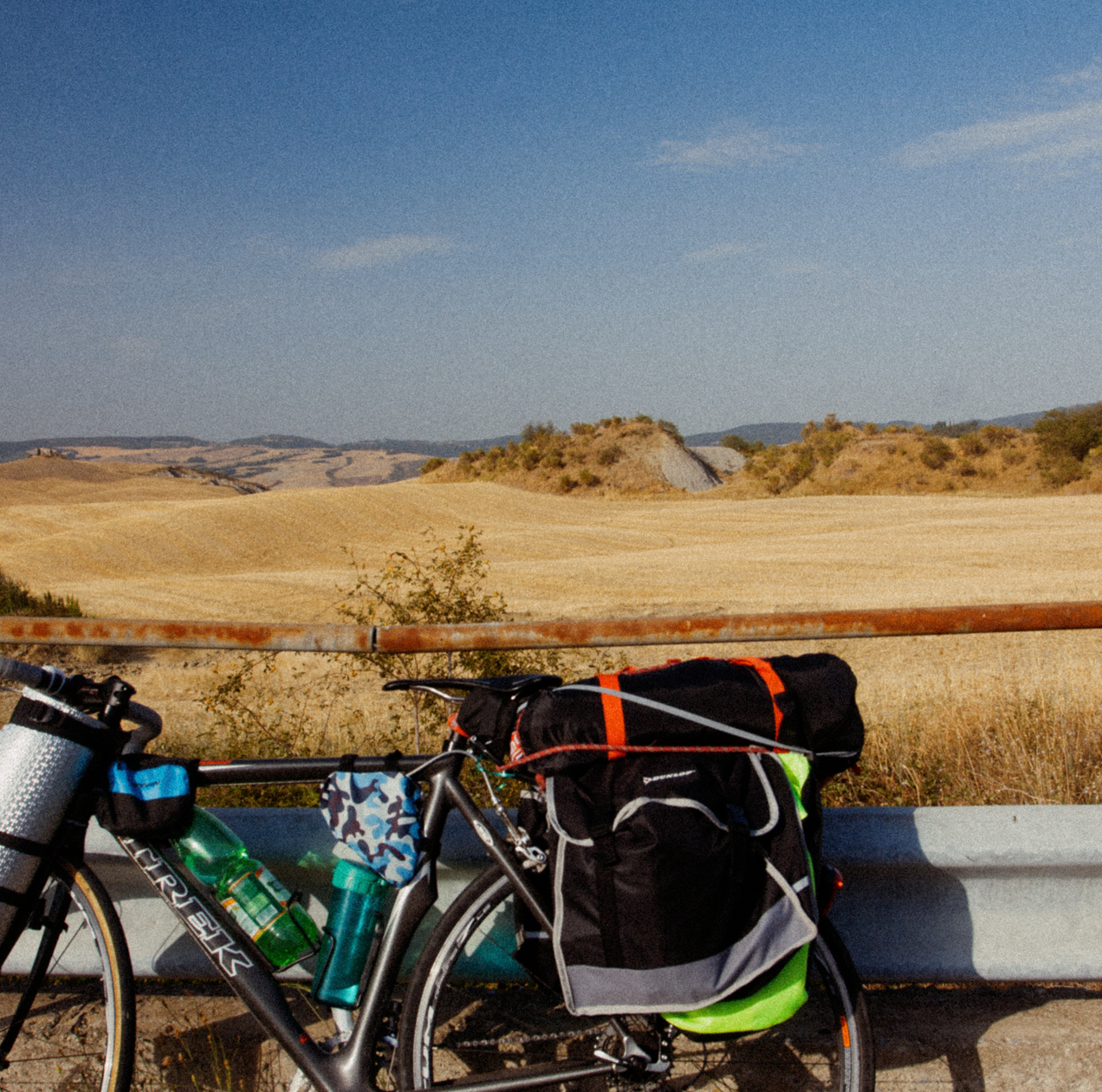
A photograph of a Tuscan road may look peaceful. But if the bicycle is leaning against a guardrail, the image may also speak of exposure. A road that looks empty may have been frightening five minutes earlier. A wide sky may mean beauty, but also heat without shade. A village street may look picturesque, but also contain the difficulty of belonging.
To understand the Via Francigena as public space is to move beyond romantic pilgrimage. The route is historical and spiritual, but it is also modern infrastructure. It passes through municipal regulations, private property, traffic systems, tourism economies, and local habits.
The road is therefore a social text.
Kinesis & Praxis reads this text through movement. The bicycle becomes a way of entering the grammar of public space: where one may go, where one may stop, how one is seen, and how the world responds to a body in passage.
No Comments