
10 Apr The Bicycle as Archive
A bicycle is usually understood as a vehicle. It carries a person from one place to another. But during a long-distance journey, especially when the bicycle is loaded with bags, tools, water, clothes, a camera, and uncertain plans, it becomes something more complex.
It becomes an archive.
Every object attached to the frame carries a story of need. A sleeping mat means the possibility of not finding a bed. A water bottle means the fear of heat. A camera means the wish to remember, but also the anxiety that memory alone will not be enough. Panniers mean self-sufficiency, but also weight. Straps mean improvisation. Dust means passage.
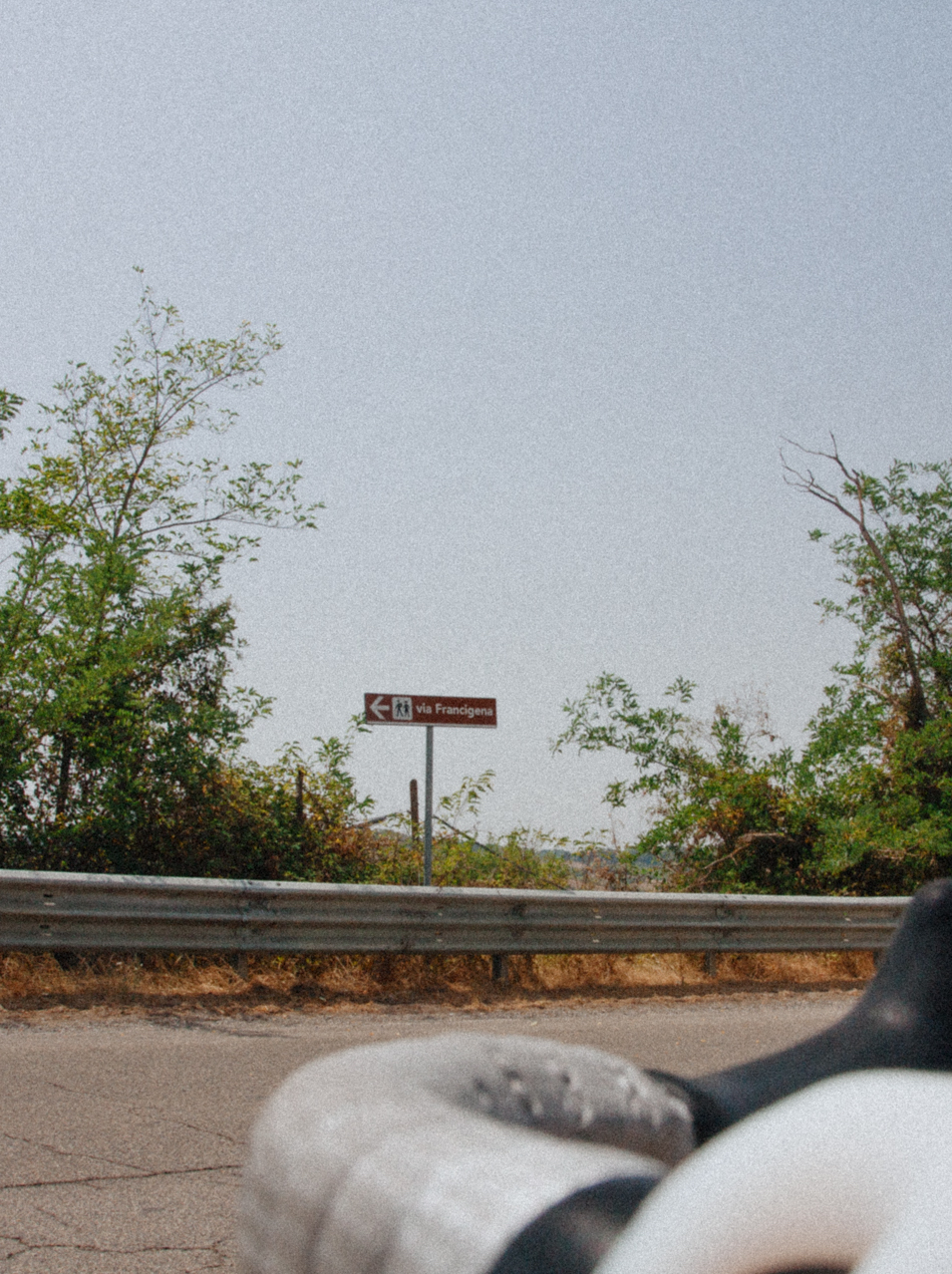
When I look back at the photographs from the Via Francigena journey, the bicycle appears again and again. Sometimes it stands against a guardrail. Sometimes it leans against a church wall. Sometimes it is half visible in the foreground, blurred by movement. Sometimes it is simply waiting beside a road, as if it too had become tired.
These images are not accidental. The bicycle entered the archive because it was never only a tool outside the journey. It was part of the experience itself.
In long-distance cycling, the bicycle shapes what can be seen. It determines the speed of perception. A car passes too quickly through the landscape, while walking may make the distance too slow for this particular project. Cycling creates a middle rhythm. It allows one to cross regions, but still remain exposed to the detail of road surface, weather, gradient, smell, sound, and social encounter.
The bicycle also changes the body. Hands become aware of vibration. Knees become aware of hills. Shoulders become aware of weight. Eyes become trained to search for shade, fountains, traffic, signs, and possible places to stop. The body becomes a sensor, and the bicycle becomes the instrument through which the sensor touches the world.
For this reason, the bicycle in this archive is not merely transportation. It is also a measuring device.
It measures distance not only in kilometers, but in difficulty. It measures hospitality by the places where it can be safely left. It measures public space by the reactions of people when a stranger places a loaded bicycle near a car, a doorway, a church, or a wall. It measures infrastructure by the presence or absence of a shoulder. It measures vulnerability by the anxiety of theft, breakdown, hunger, and nightfall.
The loaded bicycle also carries a strange social identity. It tells others that the traveler is not simply a tourist. But it does not fully make him a pilgrim either. It suggests independence, yet also reveals dependence. It shows privilege, because such a journey requires time and resources. But it also shows exposure, because the traveler is outside the protection of ordinary domestic life.
This ambiguity is important to the project.
In the photographs, the bicycle often looks small against the landscape. The road continues beyond it. The fields, hills, towns, and signs do not belong to it. Yet the bicycle insists on presence. It says: someone passed here, slowly, materially, with effort.
To build an archive around such a journey is therefore to take the bicycle seriously as evidence. Not only evidence of movement, but evidence of a particular way of knowing the world.
The bicycle does not let the landscape remain purely aesthetic. It turns beauty into effort. It turns distance into pain and patience. It turns the road into a question asked repeatedly: can I continue?
In this sense, the bicycle is one of the central characters of Kinesis & Praxis. It is companion, burden, witness, measuring instrument, and archive.
No Comments