
26 Apr The Weight of the Camera: On Rhythm, Reproduction, and the Value of Records
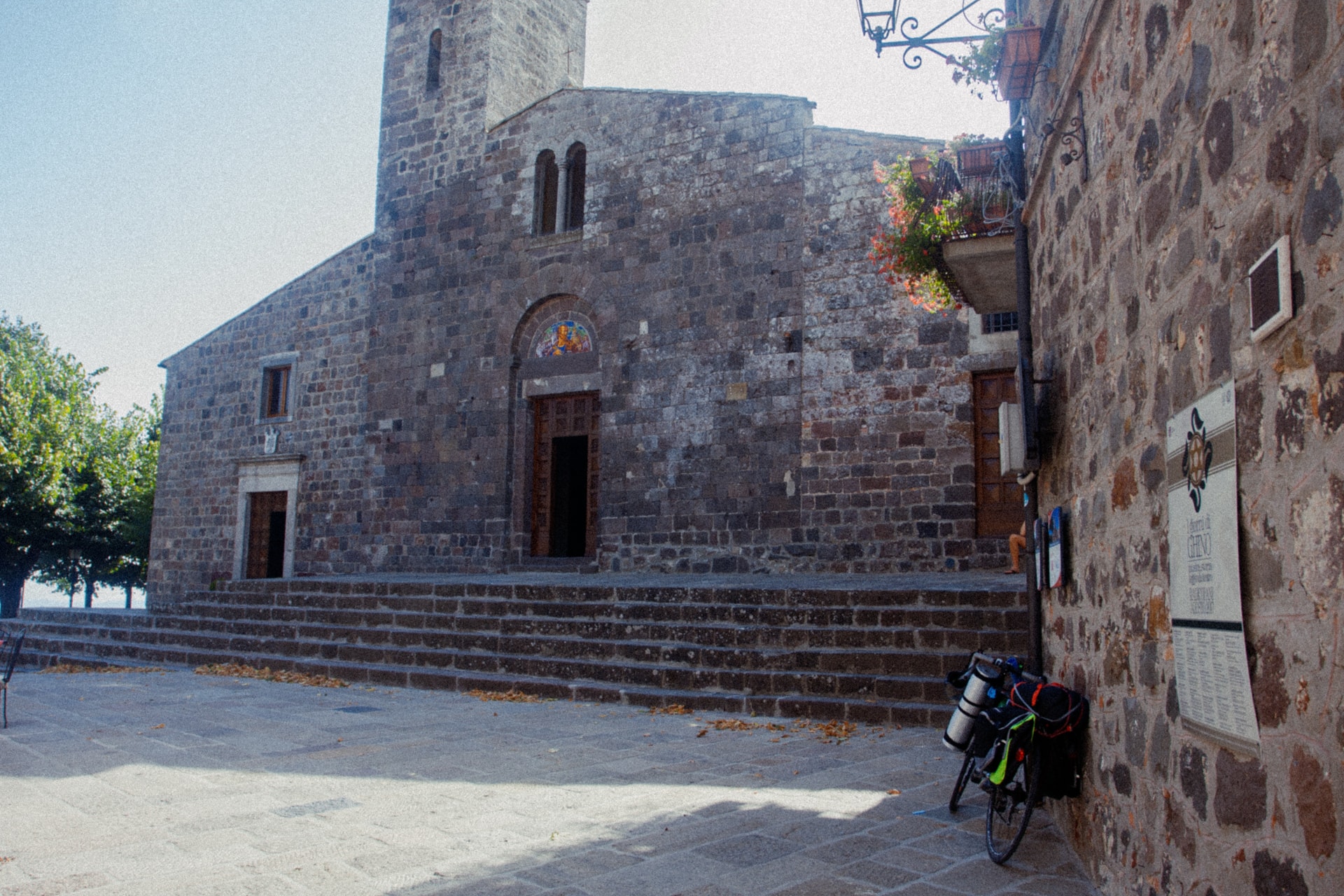
During one class discussion, Prof. Frederik Truyen looked at my Via Francigena project and raised a question that has stayed with me. I mentioned that, during the 2017 journey, I was carrying a bulky Canon 40D DSLR with a Canon EF 17-40mm USM lens. It was reliable, solid, and optically serious, but it was also heavy, large, and inconvenient on a long-distance bicycle journey.
For a cyclist, the weight of a camera is not only a technical issue. It changes the rhythm of the road.
Every time I wanted to take a photograph, I had to stop, stabilize the bicycle, take out the camera, frame the scene, shoot, put the camera back, and then return to the movement. This process may sound simple, but on a long ride it is disruptive. Cycling has its own cadence: breathing, pedaling, balancing, reading the road, watching traffic, following signs, feeling the gradient. To stop is not only to pause the body; it is to break a state of continuity.
This is why I told Prof. Truyen that I sometimes wished I had carried a more portable camera, something like a Fujifilm X100 series. Such a camera could have hung around my neck. I could have photographed more quickly, more naturally, perhaps even while remaining closer to the flow of the journey. I might have recorded more small moments: signs, faces, shadows, road surfaces, meals, rooms, gestures, and the ordinary transitions that disappear first from memory.
Prof. Truyen, who is also a photographer, immediately complicated this desire. He suggested that using a portable camera too much might make the photographs look cheap.
I understood what he meant.
The word “cheap” here does not mean only technically poor. It points to something deeper: the danger that images become too easy, too numerous, too automatic, and therefore less carefully seen. If photography becomes effortless, perhaps attention becomes weaker. If every moment can be photographed, perhaps no moment is truly chosen. A portable camera might preserve more, but it might also produce an excess of casual images that no longer carry the same weight of decision.
This reminded me immediately of Walter Benjamin’s famous essay, The Work of Art in the Age of Mechanical Reproduction. Benjamin argued that technical reproduction changes the status of art. When an image can be reproduced, circulated, and consumed endlessly, something happens to its aura, its uniqueness, its distance, and its authority.
In my situation, the issue was not exactly the same as Benjamin’s original question about art, but it belonged to the same family of problems. What happens when the act of making images becomes easier? What happens when the camera becomes more portable, more immediate, and more constantly available? Does photography become more democratic, or does it become less serious? Does abundance protect memory, or does it weaken attention?
I found myself agreeing with Prof. Truyen, but not completely.
I agreed that friction can give value to a photograph. The Canon 40D was heavy, and because it was heavy, I could not photograph everything. I had to choose. I had to stop. I had to accept that a photograph required interruption. In this sense, the camera imposed discipline. It created a threshold between seeing and recording. The image existed because I had decided that this moment was important enough to break the rhythm of riding.
There is dignity in that difficulty.
Some photographs in the Via Francigena archive probably exist precisely because they cost something. They cost time, energy, balance, and sometimes safety. To photograph a road while tired, hot, and uncertain was not a casual gesture. It meant that I wanted to hold onto that place, even while the journey was pushing me forward.
At the same time, I also felt the opposite truth very strongly. Many things were lost because the camera was too difficult to use.
On the road, there are moments that last only a few seconds: a sign passed at speed, an expression from a stranger, the arrangement of bicycles outside a bar, the sudden opening of a valley, the light on a wall, a gesture of hospitality, a moment of confusion at an intersection. If the camera is buried in a bag, these moments vanish. By the time one stops, the scene has already changed.
In this sense, the portable camera has an ethical argument in its favor.
If the experience is unique and unrepeatable, then recording more may be better than preserving an ideal of photographic seriousness while losing the evidence entirely. My Via Francigena journey was not a commercial photo assignment. It was not a controlled artistic project. It was a bodily, cultural, and personal event that I would never be able to repeat in exactly the same way.
Therefore, the question becomes difficult: is it better to have fewer images that feel more deliberate, or more images that may be visually cheaper but historically richer?
I still do not have a simple answer.
The Canon DSLR gave the archive a certain photographic gravity. The images have weight, not only because of resolution or lens quality, but because the act of taking them required commitment. The bulkiness of the camera is visible indirectly in the archive. There are gaps where I did not photograph. There are repeated views from places where I stopped. There are fewer images of fleeting encounters than I now wish I had. The camera shaped the archive not only by what it captured, but also by what it made impossible to capture.
This is an important point for digital humanities: an archive is always shaped by its recording apparatus.
The project may seem to present the past, but it actually presents the past as mediated by the available devices, habits, limits, and decisions of the time. The Canon 40D, the 17-40mm lens, the GPS recorder, the bicycle bags, the smartphone battery, the diary, the body’s fatigue — all of these were not neutral tools. They decided what could become memory.
If I had carried a Fujifilm X100, the archive would be different. There would perhaps be more images, more spontaneous moments, more social fragments, more meals, more faces, more street signs, more small transitions between one state of the day and another. But perhaps there would also be more repetition, more visual looseness, more images taken without enough attention. The archive might be richer in quantity, but less selective in atmosphere.
Prof. Truyen’s remark helped me understand that this is not only a technical question about cameras. It is a cultural question about the value of images.
Modern life is filled with photographs. We photograph meals, journeys, documents, faces, accidents, sunsets, streets, screens, and ourselves. The image has become one of the most ordinary forms of memory. But because images are so easy to make, they also risk becoming light. They circulate quickly, are consumed quickly, and are forgotten quickly.
Against this background, the heavy camera becomes almost an old-fashioned resistance. It slows the photographer down. It demands the body. It refuses total convenience. It says: if you want this image, you must stop.
But the road resists this romantic defense of slowness.
The cyclist cannot always stop. Traffic may be dangerous. The climb may punish interruption. The light may change. The group may move ahead. The body may not want to restart after stopping. Sometimes, to preserve rhythm is also to preserve survival. The portable camera, then, is not only a tool of convenience; it may be a tool that respects the movement itself.
This is where the discussion becomes sociological.
Different technologies produce different forms of life. A heavy DSLR produces one kind of traveler: selective, interrupted, perhaps more intentional, but also less able to document the ordinary flow. A small camera produces another kind of traveler: more continuous, more responsive, perhaps more attentive to fleeting details, but also at risk of over-recording. A smartphone produces yet another condition: almost total availability, but also a collapse between documentation, communication, navigation, and distraction.
The camera is never only a camera. It creates a social posture.
With a large DSLR, one appears as a photographer. The device is visible, serious, perhaps intrusive. People notice it. It changes the social relation between traveler and environment. With a small camera around the neck, one may appear more casual, but also more constantly ready to capture. With a phone, one may appear ordinary, because everyone photographs with phones, but the image may also belong immediately to the economy of platforms.
Therefore, the choice of camera is also a choice of cultural position.
In my case, as a Chinese student cycling through Italy, this question becomes even more complicated. I was not simply documenting a route. I was recording an encounter between my own biography and a European historical landscape. I was moving through Catholic pilgrimage space, Italian towns, rural infrastructures, tourist economies, and local systems of hospitality as someone both inside and outside these worlds.
This is why I told Prof. Truyen that the question touches something like cultural studies, sociology, and even a form of national autobiography.
By “national autobiography,” I do not mean that my journey represents a nation officially. Rather, I mean that a person always carries historical and cultural background with him, even when travelling alone. My way of seeing Italy was shaped by growing up in China, by studying religion and philosophy, by becoming a student in Rome, by using Western photographic equipment, by following a European pilgrimage route, and by later interpreting the archive through digital tools.
The photographs are therefore not only personal memories. They also contain traces of cultural translation.
When I photographed a road sign, a church, a bicycle, a field, or a town square, I was not only recording “Italy.” I was recording my encounter with Italy from a particular position: foreign, student, cyclist, pilgrim, amateur photographer, later researcher and developer. The archive becomes a document of movement across geography, but also across cultural identity.
In this sense, losing photographs is not only a personal regret. It is the loss of evidence for a unique historical position.
This is why I still feel sympathy for the portable camera. Even if some images might look cheaper, they might preserve moments that are otherwise completely gone. A cheap-looking photograph can still be culturally valuable. A casual image can contain important evidence. An imperfect frame can record a social relation, a gesture, a street arrangement, a sign, or a mood that no carefully composed image would have captured.
The archive teaches me that photographic value cannot be measured only by aesthetic quality.
Some images are beautiful but historically thin. Others are awkward but full of evidence. A blurred handlebar, a tilted road, a badly framed sign, or a shadow across the lens may contain the truth of movement more honestly than a perfect landscape. In a cycling archive, photographic imperfection may be part of the documentary meaning.
This brings me back to Benjamin.
If mechanical reproduction reduces aura, it also creates new possibilities of memory, politics, and access. The reproduced image may lose uniqueness, but it gains circulation. The easy image may lose solemnity, but it gains the ability to preserve ordinary life. The question is not only whether reproduction cheapens art, but also what kinds of experience become visible because reproduction exists.
For my project, the most important problem is not choosing between artistic aura and documentary abundance. The deeper task is to understand the tension between them.
The Via Francigena archive needs both seriousness and abundance. It needs images that were chosen with effort, but it also mourns the images that were never taken. It respects the weight of the Canon DSLR, but it also imagines the alternative archive that might have existed with a smaller camera. It accepts that every archive is incomplete because every recording technology creates its own blindness.
This incompleteness is not a failure of the project. It is part of its truth.
The journey was not recorded from above by an ideal machine. It was recorded by a tired body carrying a heavy camera on a loaded bicycle in August heat. The archive is shaped by that body, that camera, that road, and those interruptions. Its gaps are also evidence.
Prof. Truyen’s comment helped me see that the photographic apparatus is not outside the story. It belongs inside the interpretation of the story.
The Canon 40D was a burden, but it was also a discipline. A portable camera might have been liberating, but it might also have changed the character of attention. Between these two possibilities lies one of the central questions of the project: how should one record a life while still living it?
Perhaps there is no final solution.
To photograph is always to interrupt. Not to photograph is always to lose. The archive exists between these two losses.
Kinesis & Praxis is my attempt to return to what was captured, to acknowledge what was missed, and to understand how the weight of a camera became part of the weight of memory.
No Comments