
22 Apr Photography as Field Evidence
At first, the photographs from the journey may look like travel images: roads, bicycles, towns, landscapes, churches, fields, signs, and occasional portraits. But in this project, I do not treat them only as beautiful or nostalgic images.
I treat them as field evidence.
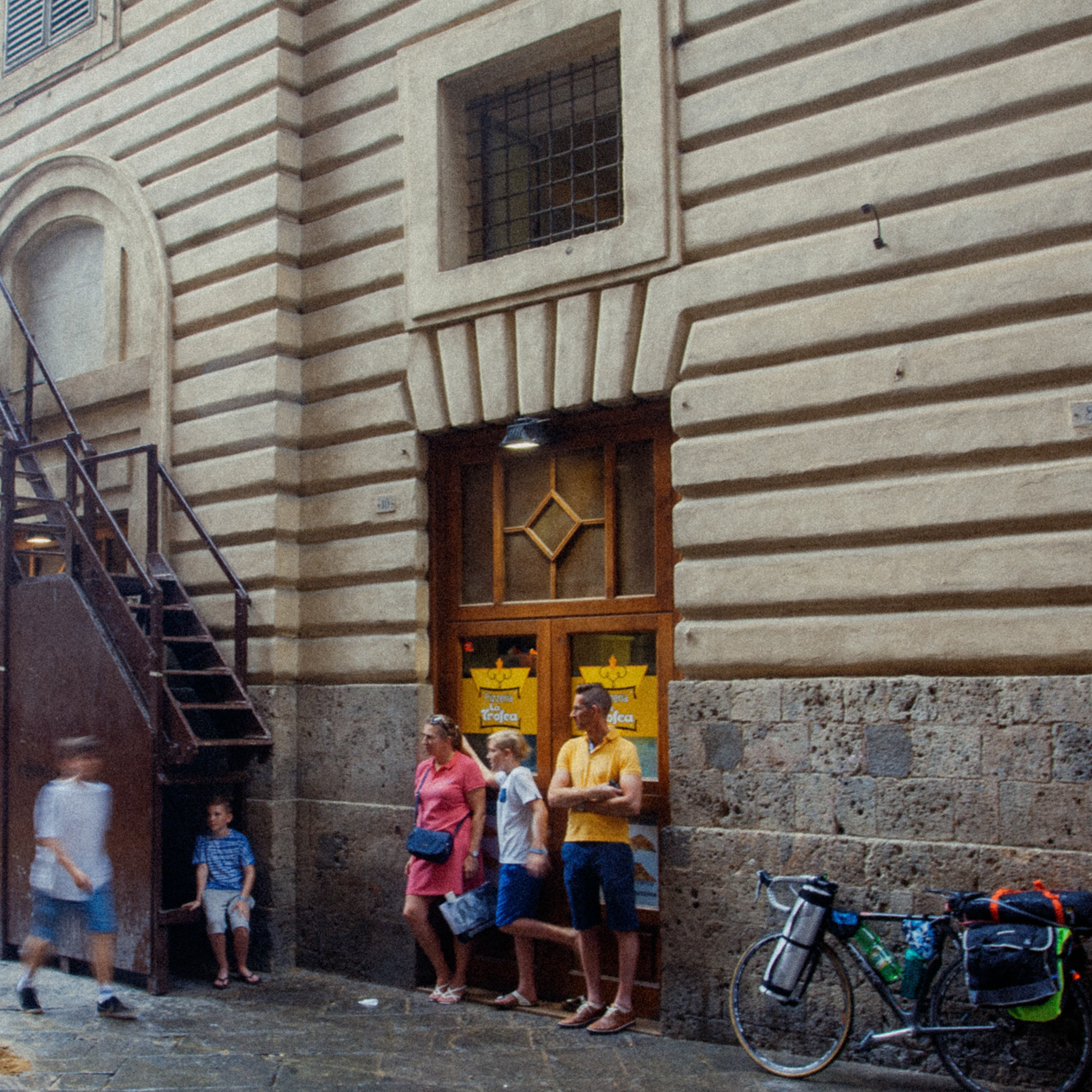
A photograph records more than what the photographer intended. It preserves accidental details: a road sign, a shadow, a crack in the asphalt, a water bottle, a blurred handlebar, a parked car, a fence, a wall, a person at the edge of the frame. Years later, these details become important because they return the memory to a specific material world.
Memory alone often simplifies. It remembers the emotional meaning of a day, but not always the exact surface of the road. It remembers fatigue, but not the shape of the guardrail. It remembers arrival, but not the small sign that marked the last turn. Photography resists this simplification.
It brings back the stubbornness of objects.
When I revisited the 2017 photographs, I often noticed things that I had not consciously seen at the time. The camera had preserved more than my attention could hold. It remembered the sky, the dust, the position of the bicycle, the direction of light, and sometimes even the evidence of my own technical imperfection: sensor spots, blur, awkward framing, overexposure, or hurried composition.
These imperfections became meaningful.
A clean photograph may present the landscape as aesthetic. An imperfect photograph often preserves the conditions of travel more honestly. Blur can show movement. Poor framing can show fatigue. A tilted horizon can show haste. A handlebar intruding into the image can show that the photographer was not standing outside the journey, but inside it.
This is why I did not want to remove all roughness from the archive.
The Via Francigena was not experienced as a series of perfect compositions. It was experienced from the saddle, from the roadside, from moments of stopping, sweating, doubting, eating, asking, and continuing. The photographic archive needed to preserve some of this instability.
Photography also creates distance. The person who took the photograph in 2017 was often concerned with immediate survival: heat, road, route, hunger, shelter. The person who reads the photograph in 2026 can ask different questions. What kind of space is this? What does this road reveal about infrastructure? Where is the bicycle placed? What kind of public or private boundary appears in the image? What does the photograph show unintentionally?
In this way, photography becomes a bridge between experience and analysis.
The AI-assisted part of the project added another layer. Visual models helped describe the photographs and generate metadata. They noticed objects, compositions, and possible geographical contexts. But AI description is not the same as memory. It can identify a road, a bicycle, a wall, or a field, but it does not know what it felt like to arrive there tired, embarrassed, hungry, or relieved.
Therefore, the archive required a dialogue between machine description and human memory.
The photograph says: this was visible. The GPS coordinate says: this happened here. The diary says: this mattered to me. The retrospective essay says: this can now be interpreted.
None of these layers is complete alone.
Photography is powerful because it appears to offer evidence. But evidence still requires reading. A photograph can prove presence, but not meaning. It can show a road, but not the moral condition of the traveler. It can show a bicycle beside a wall, but not the anxiety about whether it was safe to leave it there.
This is why Kinesis & Praxis places photographs within narrative and map. The image is not isolated. It is returned to route, time, and reflection.
The camera did not simply decorate the journey. It collected fragments of a world through which the body was passing. Years later, those fragments became the foundation of an archive.
No Comments