
Kinesis & Praxis: The Via Francigena Archive
Kinesis & Praxis is a digital humanities and spatial auto-ethnography project by YIN Renlong.
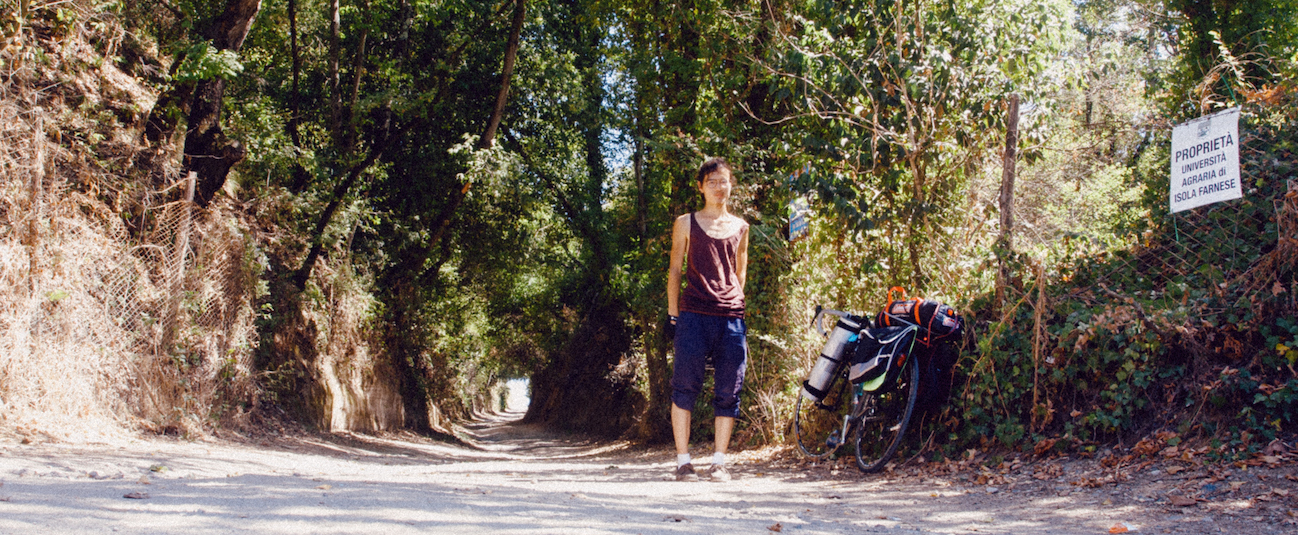
The project revisits a bicycle expedition undertaken in August 2017, following sections of the Via Francigena from Rome toward northern Italy. The original journey produced a large body of raw material: DSLR photographs, GPS/KML tracking files, personal diary notes, and memories of hospitality, fatigue, uncertainty, religious landscape, and public space.
In 2026, these materials were reorganized into an AI-augmented digital archive. The aim is not simply to document where the bicycle travelled, but to ask how movement becomes memory, how roads shape self-understanding, and how private experience can be transformed into a public cultural record.
Acknowledgments
This project was developed within the framework of the Online Publishing course at KU Leuven. Special thanks to Prof. dr. Frederik Truyen (Full Professor, Faculty of Arts / Head of CS Digital Media Lab) for his invaluable guidance, peer review, and academic mentorship. His expertise in the digitization of cultural heritage and digital humanities deeply influenced the final architectural and editorial polish of this archive.
Project Concept
The archive is built around the idea of spatial auto-ethnography. This means that the self is studied through movement, place, infrastructure, weather, hospitality, documents, and the physical limits of the body.
The journey is not presented as a heroic travel story. Instead, it is treated as a layered record of ordinary encounters: roads, signs, towns, bicycles, shelters, heat, exhaustion, welcome, refusal, and the fragile trust required to move through unfamiliar places.
Three Layers of the Archive
1. Photographic evidence
The photographs preserve roads, signs, towns, bicycles, shelters, landscapes, and accidental encounters. They are treated not only as images, but as historical and spatial records.
2. Geographic data
KML route files and GPS coordinates connect the images to movement through terrain. The interactive map allows the viewer to read the journey as both narrative and geography.
3. Retrospective interpretation
Diary entries from 2017 were revisited years later and transformed into public essays. AI tools were used to assist with visual description, metadata generation, and narrative synthesis, while the author retained editorial control.
Technical Method
Technically, the project was built as a custom static publishing engine. Instead of relying entirely on proprietary storytelling platforms, it uses Python, Markdown, HTML, CSS, Vanilla JavaScript, MapLibre GL JS, and reproducible data files.
This approach was chosen for archival stability. The project should remain readable, portable, and maintainable over time. The codebase is designed so that the archive can continue to function even when software trends, commercial platforms, or web services change.
AI and Retrospective Memory
AI tools were used as part of the retrospective process: to describe images, generate structured metadata, and help transform private notes into public-facing essays. The purpose of AI here is not to replace memory, but to create a second layer of interpretation around the original material.
The project therefore exists between two moments: the person who cycled through Italy in 2017, and the person who returns to the data in 2026 with new technical, academic, and personal distance.
Academic Context
Author: YIN Renlong
Academic context: Online Publishing, KU Leuven
Project type: Digital cultural archive, spatial auto-ethnography, AI-assisted retrospective
Fields: Digital Humanities, Theology and Missiology, Computer Science, Cartography, Travel Writing
A Public Foyer for the Archive
This WordPress site functions as the public entrance to the project. It provides context, short essays, collection views, and technical notes. The full interactive archive is presented through the map-based experience.
Enter the interactive archive:
https://francigena.yin.roma.it/map/
Project Statement
Kinesis & Praxis is a project about pilgrimage after GPS, hospitality after platforms, and the body as a measuring instrument for landscape.
KINESIS & PRAXIS: THE VIA FRANCIGENA ARCHIVE
A 2017 bicycle journey along the Via Francigena, rebuilt in 2026 as an interactive archive of photographs, GPS traces, diary memory, and AI-assisted interpretation.
Stalk us on social media profiles.
We are currently working on a new location, soon to be revealed!